Does Lake Berryessa Sweat in the Summer?
Evaporation Effects in Reservoirs and Lakes
Human beings sweat (perspire) to stay cool. The laws of physics require that when water changes from a liquid phase to a gas (water vapor) heat is required to support that transition. This is called “the heat of vaporization” and is 541 calories per gram. Boiling water takes heat from some source - fire, stove - to change it to steam. In hot weather, or when the individual's muscles heat up due to exertion, more sweat is produced. The heat source in this case is your own body. Your body heat is absorbed by sweat, which consists of 90 percent water, to change it to vapor - thus your body is cooled - especially in a breeze.
Sunlight and the air temperature support the change of lake surface water to vapor. This does not cool the lake just evaporates the surface water. And this evaporation can cause significant water loss in a reservoir during hot weather - especially in desert regions. If you stand on the shore of Lake Tahoe on a hot summer day, the far shore is obscured by haze. This is not smoke, it’s water vapor rising from the lake’s surface.
Evaporation is a large and continuing problem in the Colorado River basin, including Lake Mead and Lake Powell where about 500 billion gallons of water evaporate annually. This represents roughly 10 percent of the total natural flow of the Colorado River Basin.
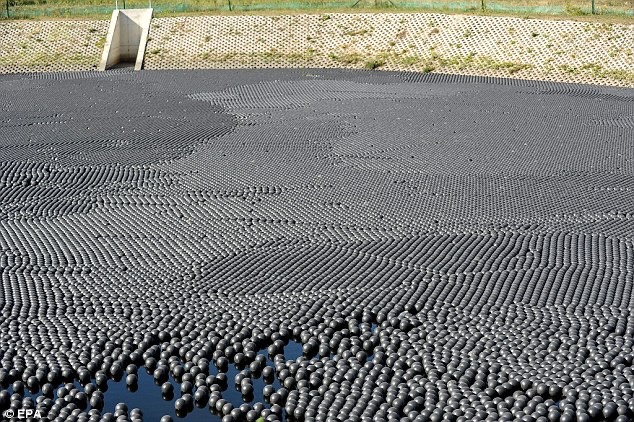
Measures to reduce evaporation included using a reflective layer on the surface. A modular floating cover stops evaporation by preventing the dry ambient air from contacting the water in the pond. These covers are particularly effective for irrigation ponds in desert climate.
Lake Berryessa has its own evaporation losses which are small but noticeable - up to one foot lake level decrease per month during summer months.
The Solano County Water Agency tracks all elements of Lake Berryessa water use with regular reports. Examples of their weekly and monthly reports for July, 2021 is shown below. Evaporation is measured in inches using actual evaporation measurements from an evaporation pan, 48" in diameter 10" deep, is located at Markley Cove.



At 700 cfs (1,400 AF/day) summer outflow, with a surface area of 17,050 AF at the 400 foot level, the lake experiences a one-foot drop every 12 days – which matches observation.

Lake Berryessa Annual Evaporation
Surface area when full: 20,700 acres. Surface Area at the 400-430 foot level: Approximately 17,500 acres.
(Evaporation is less at lower surface areas.)

Lake Berryessa Monthly Outflows from Monticello Dam

Total Winter Evaporation (2020-2021): 24,500 acre-feet (48% of Winter Outflow)
Total Winter Outflow (2020-2021): 50,946 acre-feet
Total Summer Evaporation (2020-2021): 85,489 acre-feet (48.5% of Summer Outflow)
Total Summer Outflow (2020-2021): 176,359 acre-feet
Total Annual Outflow (2020-2021): 227,305 acre-feet
Total Annual Evaporation (2020-2021): 110,000 acre-feet (49% of Total Annual Outflow)
Total Summer Evaporation (85,489 acre-feet) is 1.7 times (168%) Winter Outflow (50,946 acre-feet)
Summer Evaporation Impact on Lake Levels
July 1, 2021: 409.7 feet
July 31, 2021: 406.7 feet
Decrease: 3 feet
Decrease Due to Evaporation: 1.1 feet
Decrease Due to Outflow: 1.9 feet
% Decrease Due to Evaporation: 37%
The majority of Lake Berryessa water is released during May-September – the growing season. Peak outflow can hit about 700 CFS or 1,400 AF/day on a July day.